Spring (March through May)
Prime season: warm days, cool nights, and wildflowers threading the washes. Also the busiest window along with fall, which is when timed entry matters most.
Park Guides · Utah
Two thousand stone arches and the most famous hike in the desert.
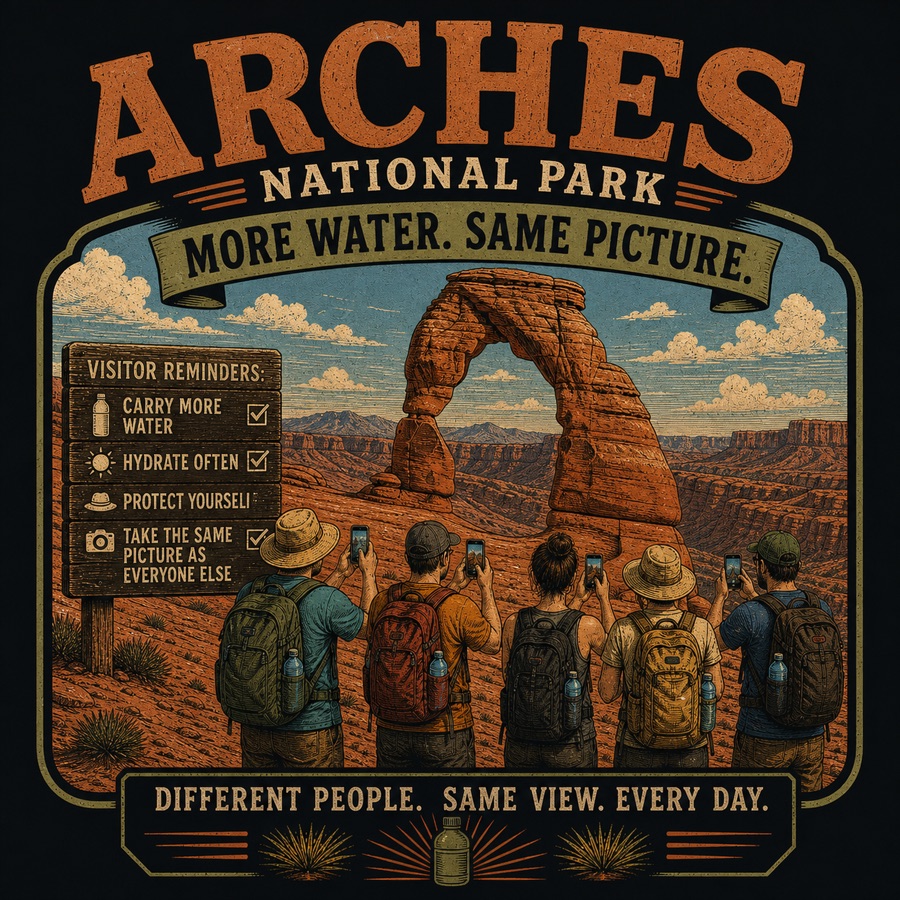
Arches holds the densest collection of natural stone arches on Earth, more than 2,000 of them, carved from salmon-colored sandstone just outside Moab, Utah. It is a compact park with one road, a handful of legendary short hikes, and a skyline that looks invented.
Its size is deceptive in both directions: you can see the icons in a single day, but the heat, the timed-entry system, and the single-road layout punish visitors who wing it. This guide covers what to see, how to time it, and the desert rules that keep a great day from becoming a rescue story.
The stops worth planning a day around.
The freestanding arch on Utah's license plate and the park's essential hike: three miles round trip over open slickrock with no shade, ending at a natural amphitheater around the arch. Go at sunrise for cool air or arrive before sunset when the sandstone glows.
The park's best scenery-per-step: a short loop reaching the massive North and South Windows and Turret Arch. Sunrise here, framing one arch through another, is a photographer ritual.
Two giant arches sharing a foundation, a few minutes' walk from the Windows parking area. You can scramble right up into the alcove beneath them, which kids treat as the best playground in Utah.
At the road's end, a flat 1.6-mile round trip reaches Landscape Arch, a 300-foot ribbon of rock so thin it has shed slabs within living memory. The trail beyond turns into a genuinely fun slickrock scramble toward Double O Arch.
A 3,600-ton boulder perched on an eroding pedestal beside the main road. The loop around it takes fifteen minutes and it is the easiest great photo in the park, especially at dusk.
A one-mile walk down a canyon of sheer fins and monoliths that early visitors thought resembled a city skyline. Best in early light, and an easy shuttle hike if your group has two cars.
A maze of narrow sandstone fins explorable only with a permit or on a ranger-led tour. There is no trail and GPS barely works between the walls, which is exactly the appeal for confident scramblers. Book well ahead.
Arches is certified dark-sky territory. On a moonless night the Milky Way rises over the fins, and the Windows or Balanced Rock make easy, safe after-dark viewpoints steps from parking.
The logistics that surprise first-time visitors.
During the busy season Arches meters daytime entries with timed tickets that sell out in advance. Early morning and evening entries typically bypass the window, but verify current rules on the official National Park Service site before your trip, because the details change year to year.
A single 18-mile scenic road serves the whole park, climbing from the visitor center to Devils Garden. There is no through-route, no gas, and limited water, so treat each visit like a small expedition: fuel, water, and snacks sorted in Moab first.
Desert air pulls moisture out of you faster than thirst reports it. Rangers recommend roughly a gallon per person per day in warm months, and there is no water available on any trail.
A proven pattern: enter at dawn, drive straight to Devils Garden before the lots fill, and work your way back toward the entrance as day-trippers stream in. Midday belongs to Moab's cafes or a siesta, not the trails.
Five minutes from the entrance with lodging, outfitters, and restaurants, Moab also serves Canyonlands and Dead Horse Point. It books heavily during spring and fall event weekends, so reserve ahead.
Midday light flattens red rock into orange cardboard. The same arch at golden hour looks lit from inside. Plan your photography, and honestly your whole day, around the edges of daylight.
The safety notes rangers repeat for good reason.
Summer highs top 100°F on shadeless rock that radiates heat back at you. Heat illness is the park's most common emergency. Hike at dawn or dusk, rest through midday, and turn around the moment anyone in your group stops sweating or feels dizzy.
Summer monsoon storms build fast, and the open rock around Delicate Arch is one of the worst places to stand near lightning. If thunderheads are stacking up in the afternoon, do the exposed hikes another time.
The dark, knobby soil crust between trails is a living colony of cyanobacteria and lichen that anchors the entire desert ecosystem. One boot print can undo decades of growth. Stay on trail or on bare rock, always.
Dry sandstone grips like sandpaper; wet sandstone is a slide. Rain also turns the Fiery Furnace and washes into flash-flood terrain. Give the rock an hour or two to dry and it comes right back to you.
Delicate Arch and Devils Garden lots fill early and stay full. Do not invent a parking spot along the road shoulder; rangers ticket it, and the desert edge you would crush is that living crust again. Have a plan B stop ready.
What each season actually feels like on the ground.
Prime season: warm days, cool nights, and wildflowers threading the washes. Also the busiest window along with fall, which is when timed entry matters most.
Summer heat breaks, light gets long and golden, and the desert is at its most comfortable. Book Moab lodging early around event weekends.
Cold mornings, quiet trails, and occasionally snow dusting red arches, which is the rarest and most beautiful version of the park. Most timed-entry requirements pause in winter.
Workable only with discipline: dawn hikes, midday retreat, evening returns. The reward is starry nights and thinner morning crowds than the shoulder seasons.
Independent park-inspired designs from our studio. Park-inspired, never official NPS merch.

Comfort Colors 17173 colors

Comfort Colors 17173 colors

Comfort Colors 17173 colors

Comfort Colors 17173 colors
Quick answers to the questions people actually ask.
Three miles round trip with about 480 feet of climbing, almost entirely on open slickrock with zero shade, plus one short ledge section near the end. Fit hikers find it easy in cool weather; in summer heat it is the park's most common rescue. Carry more water than feels reasonable.
During the busy season, daytime entry typically requires a timed ticket booked online in advance, while early-morning and evening entries do not. The exact hours and season change, so check the official National Park Service site while planning.
Yes, and many people do: Devils Garden or Delicate Arch at dawn, the Windows and Double Arch mid-morning, Balanced Rock and Park Avenue on the drive out, then sunset back at whichever icon you loved most. Two days lets you add the Fiery Furnace and slow down.
If you have two or more days in Moab, absolutely. Canyonlands' Island in the Sky district is 40 minutes away and offers enormous canyon vistas that complement Arches' close-up rock sculpture. Mesa Arch at sunrise is its signature moment.
Pets are limited to roads, parking areas, and campgrounds, and cannot go on any trail, including Delicate Arch. Summer car temperatures are lethal here, so plan pet care in Moab if you want to hike.
Conditions, reservation systems, and fees change. Always check the official National Park Service site for current information before your trip. National Park Gift Shop is an independent brand and is not affiliated with, endorsed by, or sponsored by the National Park Service or any government entity.